Gustave Moreau


Self-portrait of Gustave Moreau, 1850
French artist Gustave Moreau (1826-1898) is known for his strange and mystical works, often portraying scenes from mythology or religion. Although admired in his time, his works fell out of favor until the 1960s, when there was a revival of interest. Moreau instructed Henri Matisse and Georges Rouault, two famous French artists.

Moreau attended boarding school, the College Rollin, beginning at age 11 but left when his sister died. At the school, he won an award for draftsmanship. After he left school, his parents educated him at home, where they had a large library of books that Moreau read eagerly, including works on mythology. Moreau also studied Roman architecture, the Middle Ages, the Renaissance, the artistic themes of the Middle East and Far East, Shakespeare, and the Bible. In 1841, Moreau's mother, aunt, and uncle took him on a trip to Italy, where they visited Turin, Milan, Parma, Pisa, Florence, and Genoa. Moreau's sketchbook from this trip still exists and is kept in the Moreau Museum in Paris.

Moreau knew he wanted to be an artist and his parents supported him in his goal. In the mid-1840s, his parents showed his work to a painter, Pierre-Joseph Dedreux-Dorcy, who also encouraged him. Around 1844, Moreau began to study art with the neoclassical painter and art instructor Francois-Edouard Picot, who gave his student a solid technical foundation for his work. While studying with Picot, Moreau painted studies of nudes, copied Old Masters, and made oil sketches and large paintings.

Eugene Delacroix
In the early 1850s, Moreau met the Romantic painters Eugene Delacroix and Theodore Chasseriau, who greatly influenced his style of painting. From them, Moreau learned to love exotic romanticism, dramatic lighting, and bright colors. Moreau moved next door to Chasseriau and became interested in the latest fashions, often visiting Paris's literary and artistic salons. In 1854, Louis Moreau bought a house on the rue de La Rochefoucauld, number 14, which became the family home, Moreau's studio, and eventually the Gustave Moreau Museum.

Theodore Chasseriau
Chasseriau's death in 1856, at the age of 37, greatly upset Moreau. Unhappy with his work and saddened by his friend's death, Moreau went to Italy in 1857 to study the methods and work of Renaissance artists and the architectural remains and artifacts of ancient Greece and Rome. He traveled throughout the country, going to Rome, Florence, Siena, Pisa, Milan, Venice, Naples, and Pompeii. Italy's art deeply affected his work. "The trip also exposed him to the influence of Byzantine enamels, early mosaics, and Persian and Indian miniatures, all of which would play a significant role in the evolution of his individual style and in the jewel-like effect of his technique," noted Bennett Schiff in the Smithsonian. "At the Villa Medici in Rome, Moreau met Edgar Degas and traveled around the country with him for a while. They became fast friends, but over time, as their styles diverged, the friendship cooled."

For a very long time, it was assumed that Moreau remained single throughout his life, devotedly living with his mother until her death in 1884. However, it is now known that in 1859, he met Alexandrine Dureux, his “best and unique friend”. Sometimes labelled his “mistress”, it seems she was more like his muse, if not soulmate. They were united for 27 years, but never married, for unknown reasons. All of his correspondence with Alexandrine was burnt by the painter himself, which is why it took decades before their relationship was discovered.  
Project for the tomb of Alexandrine Dureux


Shortly after his mother had died, Alexandrine took ill herself and she became worse in 1889. When she died the following year, he constructed a monument in the cemetery of Montmartre, near to where he knew he would be buried later. He also painted “Orpheus on the tomb of Eurydice”, a very mythical theme about soulmates, thus underlining how he saw the bond that he and Alexandrine shared.

Orpheus on the tomb of Eurydice
Moreau painted for a number of years without exhibiting his work, but during this time he developed his unique style. The colors he used reflected the Romantic style, but his figures were static. He spent many hours studying Persian, Indian, and Japanese prints and from them took motifs, which he used to create his own vision of myths and religions.

In the Salon of 1864, Moreau exhibited his painting Oedipus and the Sphinx, the work that launched him into prominence. To Moreau, the work represented man facing the eternal mystery with moral strength and self-confidence. "Outstanding examples of psychological and physical detachment can be seen in one after another of Moreau's paintings," wrote Schiff. "In Oedipus and the Sphinx (1864), for instance, the winged creature—half nude female, half lion, an incubus clawed into Oedipus' breast— does not seem to inflict pain at all. Instead, the grotesque creature and its placid victim appear to be dreamily engrossed in each other, although Oedipus is soon to answer the Sphinx's riddle and she, or it, is to fall dead to the ground, finally, having already shredded any number of hapless voyagers unable to answer the riddle. Their bits and pieces are, in Moreau's superbly rendered canvas, strewn about the foreground." Finally, Moreau had achieved formal recognition of his talent. From then on, he helped re-energize the tradition of history painting, giving epic tales poetic imagination, exoticism, and wonder.


In the Salon of 1865, Moreau exhibited Young Man and Death and Jason and Medea. In 1866, he showed Orpheus and Diomedes Devoured by his Horses. He exhibited each year in the Salon through 1869, when his works were criticized in the press. After that he sold a few paintings to admirers but rarely left his studio.

In 1876, he began to exhibit in the Salon again, showing three of his most famous paintings: Hercules and the Hydra, Salome Dancing Before Herod, and The Apparition. He last exhibited in the Salon in 1880, showing Galatea and Helen.

Moreau was devoted to Alexandrine Dureux for 31 years, until her death in 1890 at age 54. After her death, Moreau's style altered. "His brushwork became looser and more expressive; his pigment grew thicker, more impastoed; and his forms became increasingly abstract," Schiff wrote. "The overriding effect of these later paintings was to evoke an emotional response through the use of color, line and form. Some even view his later nonfigurative works as heralds of Abstract Expressionism. Certainly his art inspired a generation of Symbolist painters, poets and writers and had a marked impact on other artists, including the Surrealists and the radical group known as the Fauves."

In 1888, Moreau was elected to the Academie des Beaux-Arts. At age 65, he became a professor in charge of a studio at the Ecole des Beaux-Arts. He was considered the last great teacher there. He taught Georges Rouault, Henri Matisse, and others, developing their natural talents and encouraging them to use color imaginatively.

In 1895, Moreau remodeled his house into a four-story building to create a museum for his works. He died of stomach cancer in Paris on April 18, 1898. Moreau left to the state his home and its contents, about 1,200 paintings and watercolors and roughly 10,000 drawings. Moreau sold about 500 works while alive, and these are in other collections and museums.

From about 1914 until 1960, art historians lost interest in Moreau, viewing him as an eccentric, although he was always considered a great teacher. In 1961, a large retrospective of Moreau was held in Paris at the Louvre, which led to more exhibitions in the 1960s. In 1974, the Los Angeles County Museum of Art held an exhibition and so did the Zurich Kunsthaus in 1986. In 1998 and 1999, an exhibition of his works appeared in Paris, Chicago, and New York. "Exactly where Moreau fits in, and his real place in art history, is as difficult to determine in 1999, however, as it was in 1899," wrote Laura Morowitz in The Art Bulletin. "Perhaps our only safe judgment is to agree with the critic Theophile Gautier, writing a century and a half ago, that ' … his work stands in singular isolation, and whether it pleases or not, one has to reckon with it."'


Monet's Sketchbook


Monet's Sketchbooks From the Musee Marmottan Monet, Paris

This digital presentation of Monet's sketchbooks gives unprecedented public access to works that are among his least refined yet some of his most intimate artistic utterances.


The exhibition of Monet's Sketchbooks challenges the conventional, long-held understanding of Claude Monet's artistic process and life. Drawing upon recently discovered documents and a body of graphic work largely unknown to the public and scholars alike, the exhibition reveals that Monet (1840–1926) relied extensively upon drafting in the development of his paintings in addition to painting his subjects directly.

Monet habitually carried sketchbooks with him in his teenage years when he went on expeditions to draw landscapes. He then made use of sketchbooks from the very beginning of his professional career in the 1860s through to the 1920s.

Monet seems to have used sketchbooks in a strictly functional and utilitarian way to make drawings for their own sake - e.g. drawings of his children and to jot down visual ideas for exploratory purposes - both at home, Paris and other parts of France and abroad. The graphic language of his sketches varies from the spare and minimalistic (outlines only) to evidence of retracing which suggests working on composition and design

Woman With A Parasol

Tree Trunks At La Mare Eu Clere

Jean-Pierre Hoschedé and Michel Monet Drawing and Germaine Hoschedé Writing


Claude Monet


Claude Monet was the second son of Claude Adolphe Monet and Louise Justine Aubrée Monet. His parents were second-generation Parisians.

Monet’s Father Adolph
Monet was drawing by the age of 5. His first drawings tended to be caricatures of the teachers that he had in school. He was known to fill entire school books with drawings instead of the assignments that were due. Over time, after his family moved to the community of Le Havre, Monet became famous in his own right for the drawings he would create of the town’s residents. His father hated all of the drawing and creativity. His goal was to have his son join in on the grocery business. His mother, however, completed supported every artistic endeavor Monet attempted. Monet’s mother Louise-Justine was an elegant woman and trained soprano who loved to paint and write poetry. "Mme Monet was a consummate hostess who filled their ornately decorated home with music and cultured guests.

On April 1, 1851, Monet entered Le Havre secondary school of the arts. Monet was a very bad student at school. He was drawing a lot of caricatures for his friends and teachers. His talent was highly appreciated and the drawings were sold well. Despite his interest in caricatures Monet couldn’t see himself as an artist until he met his mentor, Eugene Boudin who suggested that Claude should draw outdoors. The school of arts didn’t encourage Monet a lot as he didn’t share the educational views of teachers there and left the school soon.

At the age of 17, Monet’s mother passed away and so he went to live with his aunt so that he could pursue an art education in Paris. Despite the opportunity to study art, Money decided to join the military in 1859. It was a 7 year assignment that he had agreed to serve, but in his second year of service, he contracted a bad case of typhoid fever. At the pleadings of his aunt, Monet was released from the military on one condition – he had to complete an art course at an accredited school.

After his mother died, Monet left school and went to live with Marie-Jeanne Lecadre, his widowed childless aunt.


In June 1861, Monet joined the First Regiment of African Light Cavalry in Algeria for a seven-year commitment. However, after two years later, he had contracted typhoid fever. The army agreed to release him from his service commitment at the pleas from his aunt, but only if he agreed to complete an art course at an art school.

In 1862, Monet met Pierre-Auguste Renoir, Frédéric Bazille and Alfred Sisley while he was a student of Charles Gleyre in Paris. They discussed the effects of light with broken color and rapid brushstrokes which is the mark of Impressionism.

Jacques-François Ochard gave Claude Monet his first drawing lessons.

Eugène Boudin, an artist and Monet’s mentor, taught him to use oil paints and techniques.


Monet painted Impression, Sunrise (Impression, soleil levant) in 1872.


It depicts a Le Havre port landscape. In 1874 it hung in the first Impressionist exhibition. When art critic Louis Leroy read the painting’s titled, he coined the term “Impressionism”. Leroy meant his assessment to be negative, but the Impressionists at the time approved of description and it stuck.

 
The Woman in the Green Dress (La femme à la robe verte) was painted in 1866. This painting brought him recognition and was one of many works featuring his first wife, Camille Doncieux.

Camille Donieux was still in her teens when Monet met her around 1865. Although she was of humble origins and worked as a model, she was an attractive, intelligent girl with dark hair and wonderful eyes. Camille was seven years younger than Monet who was just a poor painter at that time. Camille became his girlfriend, mistress and model. Unfortunately, the couple lived in depressing poverty. Right up to her death she sat for him regularly, appearing frequently as a female figure in a rural landscape. Some of these canvases are among Monet's finest masterpieces.

Shortly before leaving Paris for Trouville, Camille and Claude were married in a civil ceremony performed at the town hall of the eighth arrondissement. The rebellious French painter Gustave Courbet was one of the witnesses. Camille's parents were present, and the affair was conducted with proper formality. All that marred the occasion was the absence of Monet's farther and aunt, who regarded the union as a disastrous misalliance.

Riding on his success (and his earnings) from Woman in a Green Dress, Monet quickly launched into his next major work: Women in the Garden. He planned to execute this project on a canvas that measured over eight feet in height, attempting to capture the effect of light falling through trees on a group of women enjoying a leafy, sun-filled garden. Camille again served as his model, posing for all four figures that appear in the painting, and as a result they all bear a strong resemblance to each other.  Despite Monet’s effort, the Salon’s jury rejected Women in the Garden which he submitted in 1867. This was not a total surprise for Monet, though, as the Salon looked with disfavor on art that was outside of the academic standards of the time, which Monet’s clearly was.

After the failure of Women in the Garden, again on the brink of economic ruin, and with Camille pregnant, Monet had to return home to Le Havre to make peace with his family, who were threatening to cut off his allowance, and while he was away Camille gave birth to their first son, Jean. He also wrote desperate letters to his friends, among them Bazille, begging them to loan him money.

Monet tried to commit suicide by drowning in the Seine river after their first son’s birth having faced the financial difficulties that seemed overpowering that time. Claude’s father rejected him for the reason of Camilla’s unlawful pregnancy. Thanks to Edouard Manet, the fact of selling several paintings and Camilla’s support Claude Monet surpassed the troubles and obtained a new start in life.

Water lilies, 1897-1899, Galleria Nazionale d’Arte Moderna


Claude Monet painted the Weeping Willow series of works as a contribution to the fallen soldiers of France during the war.

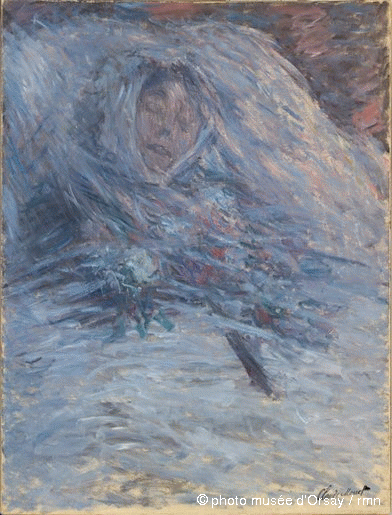
Monet and his wife had two sons together, but when their second son was born in 1878, her health was not good. She was already suffering from tuberculosis and then she was diagnosed a little later on with uterine cancer. She passed away just a year later and Money painted his wife while she was on her deathbed. It may have been well over a century ago, but it is still one of the most intense paintings that anyone will ever see.


Monet's later years were marked ith visual deterioration. He had to undergo surgery for cataract removal that had hindered his sight for about 10 years. During his work on Water Lilies, the most ambitious and famous one his eyes were more and more immersing into darkness. Water Lilies were painted from nature in his own hand made garden in Giverny.

In 1890, Monet purchased the house and land outright. After becoming the owner, he created the gardens which he would spend the rest of his life painting.

Monet wrote designs and layouts for plantings for his gardener. Even though Monet eventually hired seven gardeners, he still remained the architect.


Alice Hoschedé Monet.
In 1876, Ernest Hoschedé commissioned Monet to paint decorative panels for the Château de Rottembourg and several landscape paintings. According to the Nineteenth-century European Art: A Topical Dictionary, it may have been during this visit that Monet began a relationship with Alice Hoschedé and her youngest son, Jean-Pierre, may have been fathered by Monet.

After Camille Monet's death in 1879, Monet and Alice (along with the children from the two respective families) continued living together at Poissy and later at Giverny. Still married to Ernest Hoschedé and living with Claude Monet, the Le Gaulois newspaper in Paris declared that she was Monet's "charming wife" in 1880.

Ernest Hoschedé died in 1891 and Alice agreed to marry Monet in 1892 .

Alice Hoschedé helped Monet to raise his two sons, Jean and Michel, by taking them to Paris to live alongside her own six children.

In 1911, Monet’s second wife, Alice, died.

In 1914, Monet’s oldest son Jean, died in 1914.

After his wife died, Alice’s daughter, Blanche, cared for Monet even as he developed the first signs of cataracts

On December 5, 1926, Monet died at the age of 86 and is buried in the Giverny church cemetery.

Monet had insisted that the occasion be simple; thus only about fifty people attended the ceremony

Monet, right, in his garden at Giverny, 1922.

His home, garden and waterlily pond were bequeathed by his son Michel, his only heir, to the French Academy of Fine Arts (part of the Institut de France) in 1966.


Cézanne's Studio at Les Lauves


After 1878, he spent much of the rest of his life painting in Provence. Relatively isolated from the Paris art scene, Cézanne pursued his own artistic path. While the Impressionists depicted changing light and atmospheric effects, he was more interested in studying the underlying structure of the landscapes he painted. He said, “I wanted to make of Impressionism something solid and enduring like the art in museums.” Few of his works sold and he did not show his art publicly for almost twenty years.

In November 1901 the artist, then 61, bought a plot of land at Les Lauves, an area of open countryside in the hills north of Aix. A simple two-storey house was built, and on 1 September 1902 Cézanne started working there.


Each morning he would rise very early and walk the 1.2km / 0.7 miles up the hill to the studio. He'd work there from about 6am to 10.30am, return to Aix for lunch, then go back to paint until 5.30pm, either in the studio or further up the hill at a vantage point offering superlative views of the Mont Sainte Victoire.

Interior of Cezanne's Studio
The Back Wall of Cezanne's Studo

Cezanne's Paint Box

Cezanne's studio at Les Lauves: facade and terraceIt was up here, in autumn 1906, that Cézanne got caught in a rainstorm and was taken home unconscious in a laundry cart. He rose again early the following day to work on a portrait of Vallier, his gardener.

Paul Cézanne, Exiting his Studio 1906 - by Gertrude Osthaus

But his condition worsened and he died of pleurisy six days later during the night of 22-23 October. "I have sworn to die painting," Cézanne had written only a few days earlier. And he did.

The studio remained empty for 15 years. It was bought in 1921 by one Marcel Provence, who lived there until his own death in 1951.


L'œuvre by Emile Zola


Paul Cézanne, Paul Alexis reading to Émile Zola, 1869–1870, São Paulo Museum of Art

L'œuvre is a fictional account of Zola's friendship with Paul Cézanne and a fairly accurate portrayal of the Parisian art world in the mid 19th century. Zola and Cézanne grew up together in Aix-en-Provence, the model for Zola's Plassans, where Claude Lantier is born and receives his education. Like Cézanne, Claude Lantier is a revolutionary artist whose work is misunderstood by an art-going public hidebound by traditional subjects, techniques and representations. Many of the characteristics ascribed to Claude Lantier are a compound taken from the lives of several impressionist painters including Claude Monet, Édouard Manet, as well as Paul Cézanne. Zola's self-portrait can be seen in the character of the novelist Pierre Sandoz.

The book is often blamed for ending the friendship between Cézanne and Zola. The story of a groundbreaking artist unable to live up to his potential must have seemed intensely personal to Cézanne; no correspondence exists between the two after a letter in which Cézanne thanks Zola for sending him the novel.

The novel covers about 15 years, ending in 1870. Besides depicting the bohemian art world of 19th-century Paris, L'œuvre explores the rise of Realism, Naturalism and Impressionism in painting. Zola also looks at contemporary sculpture, literature, architecture, music and journalism, as well as the commodification of art. In creating his portrayal of the Parisian art world Zola includes several characters who are composites of real-life art world related figures; artists, writers, art dealers, and friends that he knew.

ZOLA 1902B.jpg
Emile Zola


Madame Cezanne: Muse or Object?

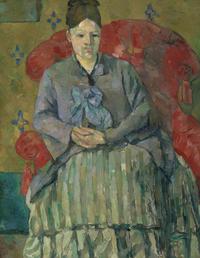
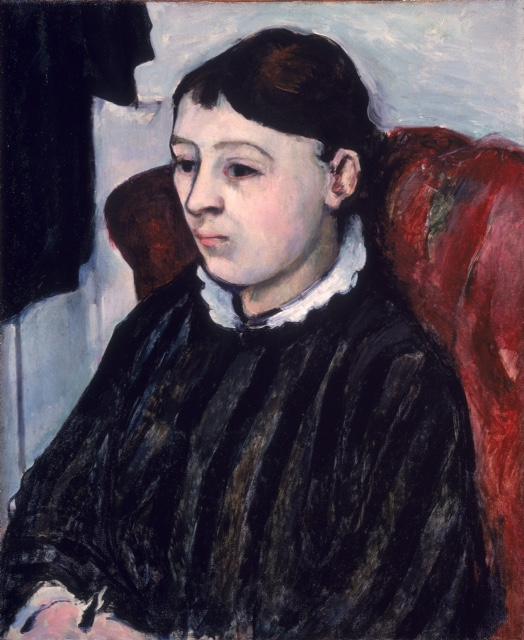
Paul Cézanne, Madame Cézanne in a Red Armchair, about 1877 (Museum of Fine Arts, Boston)

Hortense Fiquet is a mystery in the art world.


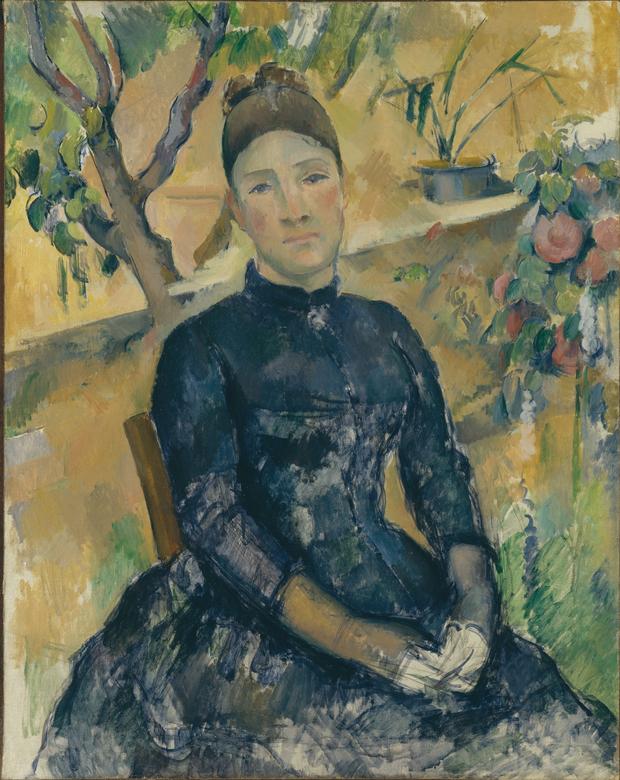
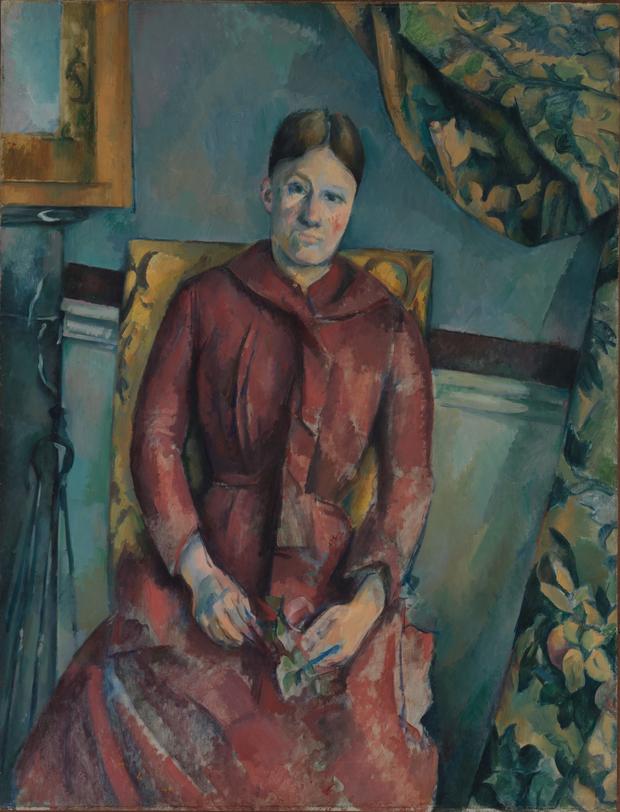
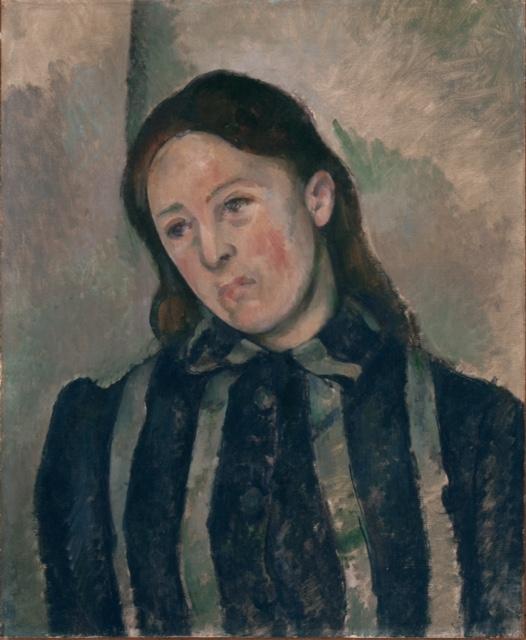
She sat for 29 paintings by her husband Paul Cezanne, more than any other model, and smiles in none of them. She was ignored by the French artist's family, friends, and hidden for 17 years before they got married, even though she was the mother of his only son Paul.

In this interview, art critic Deborah Solomon said Madame Cezanne is the opposite of what we think of as a muse She is always portrayed at home, with her hair parted in the middle and her dress buttoned up. She looks sad, bored. "She was not created for the male gaze, you cannot turn her into a sex symbol," she said. Solomon said she sees madame Cezanne as the the anti-Mona Lisa. "Mona Lisa has always intrigued us because nobody knows why she is smiling. But in the case of Madame Cezanne we don't know why she is frowning."


Cezanne and Fiquet met in Paris in 1869, when she was 19 and he was 30. The painter kept their relationship secret for 17 years, mostly out of fear of his banker father. It's believed he finally married her to make his son Paul a legitimate heir of the family fortune.

Philippe Cezanne, the great grandson of Paul and Hortense Cezanne, was in New York City for the opening of the show and he said Fiquet is now seen differently in the family. “I think she was much more important for Cezanne than usually, you know, art history says,” he said.

Cezanne said she took care of the painter, and accepted everything. “In Paris they changed about 20 times of apartment, or flat, so she never know where she was,” he said.

Solomon said the show is fascinating, because it offers a glimpse on the birth of modern art, through 20 years of paintings by Cezanne. "Over that time you can see how he was experimenting with what he called visual sensations. He wasn't interested in capturing her personality, rather he wanted to reflect how she appears to him as he changes angles and moves around a room," she said.

Solomon said the Madame Cezanne paintings show that Cezanne saw Fiquet more like an object than a muse, the opposite of Picasso's paintings of his last wife Jacqueline Roque. "Cezanne had no interest in glamorizing the individual, he was interested in form, rather than flesh," she said.


Paul Cézanne

Paul Cezanne - Self Portrait

Paul Cézanne French artist and Post-Impressionist painter whose work laid the foundations of the transition from the 19th-century conception of artistic endeavour to a new and radically different world of art in the 20th century.

 Paul Cézanne was born to a wealthy family in Aix-en-Provence, France. His father was a successful banker whose riches assisted Cézanne throughout his life and his mother was a romantic who supported her son's career.

In 1852 Cézanne entered the Collège Bourbon where he met his good friends Émile Zola and Baptistin Baille. The three were famously close for a long period of time. After a classical education in Aix-en-Provence Paul Cézanne's father wished him to become a lawyer. However after attending law school for two years (whilst receiving art lessons) he could not bear the thought of continuing his education and left for Paris.

In Paris Paul Cézanne spent a large period of his time with Émile Zola, a French writer. He enrolled at the Académie Suisse, which is where he met his mentor, Camille Pissarro. After five months of trying to work as a painter in Paris, France, to no critical success, Cézanne returned to Aix-en-Provence at his father's request.

In his home town Paul Cézanne enrolled at the local art school and attempted to work as a banker but was also unsuccessful in this venture. Consequently in 1862 he returned to Paris to work as a painter. Disappointingly he failed the entrance exam to the Ecole des Beaux-Arts but continued to work between Paris and Aix-en-Provence and submitted many of his works to the Salon jury.

In 1869 Cézanne Met Mrie-Hortense Fiquet at an art school in Paris called Académie Suisse. Fiquet's main job was as a bookseller or bookbinder, but she combined this with part-time work as a model. They started a relationship and when the Franco-Prussian War broke out in 1870, they left Paris together for L'Estaque in the south of France. Afraid of offending his father, Louis-Auguste Cézanne, a well-to-do banker, and compromising his allowance, he went to great lengths to conceal his liaison with Fiquet. The existence of their child Paul, born in 1872, was kept from Louis-Auguste for some years.


Portrait of the Artist's Son - Paul Cezanne


Paul Cézanne's work was misunderstood by his contemporaries. A shy man who worked a great deal in Aix-en-Provence, the home town where he was born and raised, Cézanne moved Paris when he was young and, despite his father's wishes, pursued a career in art rather than law.

Cézanne was a modern artist whose work was a precursor for Cubism and Fauvism. His compositions were usually dark in tone and he often chose to work inside rather than en plein air.

Cézanne didn't receive critical acclaim until very late in his life and after his first solo exhibition. He never formed close friendships with many of his fellow artists but before he died there was a great deal of interest in his works.

Paul Cézanne's modern style and technique was avant-garde and therefore misunderstood for many years. Even the other breakthrough artists of his era, the Impressionists, were dismissive of Cézanne's progressive style and method. After the first Impressionist exhibition many of them petitioned to have him banned from the other shows because Cézanne's compositions were too controversial.

Camille Pissarro
Cézanne worked with thickly placed layers of paint and undefined forms and attempted to simplify everything into shapes that could be broken down. Although he was close with the Impressionist Camille Pissarro, and influenced by Pissarro's en plein air style of painting Cézanne was not an Impressionist. He was a highly modern artist who did not fit into any one category of painting style. His style was a precursor for the fauvism and cubism movements.

In 1872 Paul Cézanne was living in Pontoise, France with Hortense Fiquet and his newborn son Paul (whom his father did not know about). Cézanne was still enthusiastically working on his paintings and was spending time outside with his idol, Camille Pissarro.

In Pontoise Paul Cézanne met Dr Paul Gachet, who was an admirer of his work and thus spent the years of 1872 to 1874 living at Gachet's home in Auvers-sur-Oise.

In 1873 Cézanne met Vincent van Gogh and in 1874 he exhibited at the Impressionist's first showcase. Cézanne's work was highly criticized along with the Impressionist's paintings but Cezanne's paintings were disliked by the other painters too. Cézanne's compositions from this period of working close to Camille Pissarro reveal that he was slightly influenced by the Impressionist's en plein air style of painting.

In 1877 Cézanne showcased 16 of his paintings to a great deal of scorn from critics and vowed never again to show his work at an Impressionist's exhibition. Although still influenced by Pissarro's Impressionist style Cézanne continued to work inside his studio and didn't believe in always painting from nature.

Emile Zola

In March 1878, Cézanne's father found out about Hortense and threatened to cut Cézanne off financially, but, in September, he relented and decided to give him 400 francs for his family. 

In the early 1880s Cezanne started to move even further away from the Impressionist's style of painting. The year 1886 was a turning point for the family. Cézanne married Hortense and He fell out with Emile Zola because of his interpretation of Zola's novel, L'Oeuvre, and the two never saw each other again. In 1886 Cezanne married his mistress and inherited a large estate from his father, meaning he never had to worry about making money from his art.

In November 1895 Paul Cézanne held his first solo exhibition in Paris and Ambroise Vollard bought every artwork. He then moved to Aix-en-Provence permanently.


View of the 1904 Salon d'Automne, photograph by Ambroise Vollard, Salle Cézanne (Victor Choquet, Baigneuses, etc.)

In the early 1900s his work was shown all around Europe to wide critical acclaim but throughout his life Cézanne was shy and hostile towards other painters and he maintained this attitude. He died in October 1906 of pneumonia and is buried in the cemetery in Aix-en-Provence.


Sources: Wikipedia and Artable