Mongrel Patriot Review: Musician and Writer Art Johnson


Judging by his work with Tim Buckley, Manly P. Hall, Robert Altman, Lena Horne, this cool cat, sideman to legends, is to the best of my knowledge the original Silverlake hipster. Art Johnson started living there in the early 80’s. His monastic cell featured fabulous musical instruments and a lean but weighty collection of old esoteric tomes. He and his circle of mostly musician and poet friends were definitely up to something, and where else could you see an original edition of Blake, the set put together by Yeats? He was a moody bastard, some girl in France. When he’d see her music would pour out of him like a mockingbird in spring.

Where do you even start to tell stories about this guy? He has played an orchestra of instruments including Renaissance lute, and when I say play I mean really play the hell out of an instrument the way it’s meant to be played, with plenty of research and practice.

He toured with Lena Horne, Tim Buckley, Paul Horn, The Association, Pat Boone, Allan Holdsworth, Jobim, Engelbert Humperdinck while working on music for TV shows and in movies.

I’ve heard tales of the naked nymphs of Laurel Canyon with silver trays full of illegal treats at the house of Stills or some other mainstay of the hippie scene. Ever hear of Skip Battin, member of The Byrds, the New Riders of the Purple Sage, and the Flying Burrito Brothers? He played in a pioneer fusion band in Laurel Canyon with Art on guitar. But that’s just Laurel Canyon.

Art has played Carnegie Hall, The Kennedy Center for the Performing Arts, the Sporting Club in Monte-Carlo and the Dorothy Chandler Pavilion, not to mention Shelly’s Mann Hole. But his gigs in the black clubs of downtown San Diego in the sixties, and in the last of the Los Angeles joints in Crenshaw, were just as thrilling.

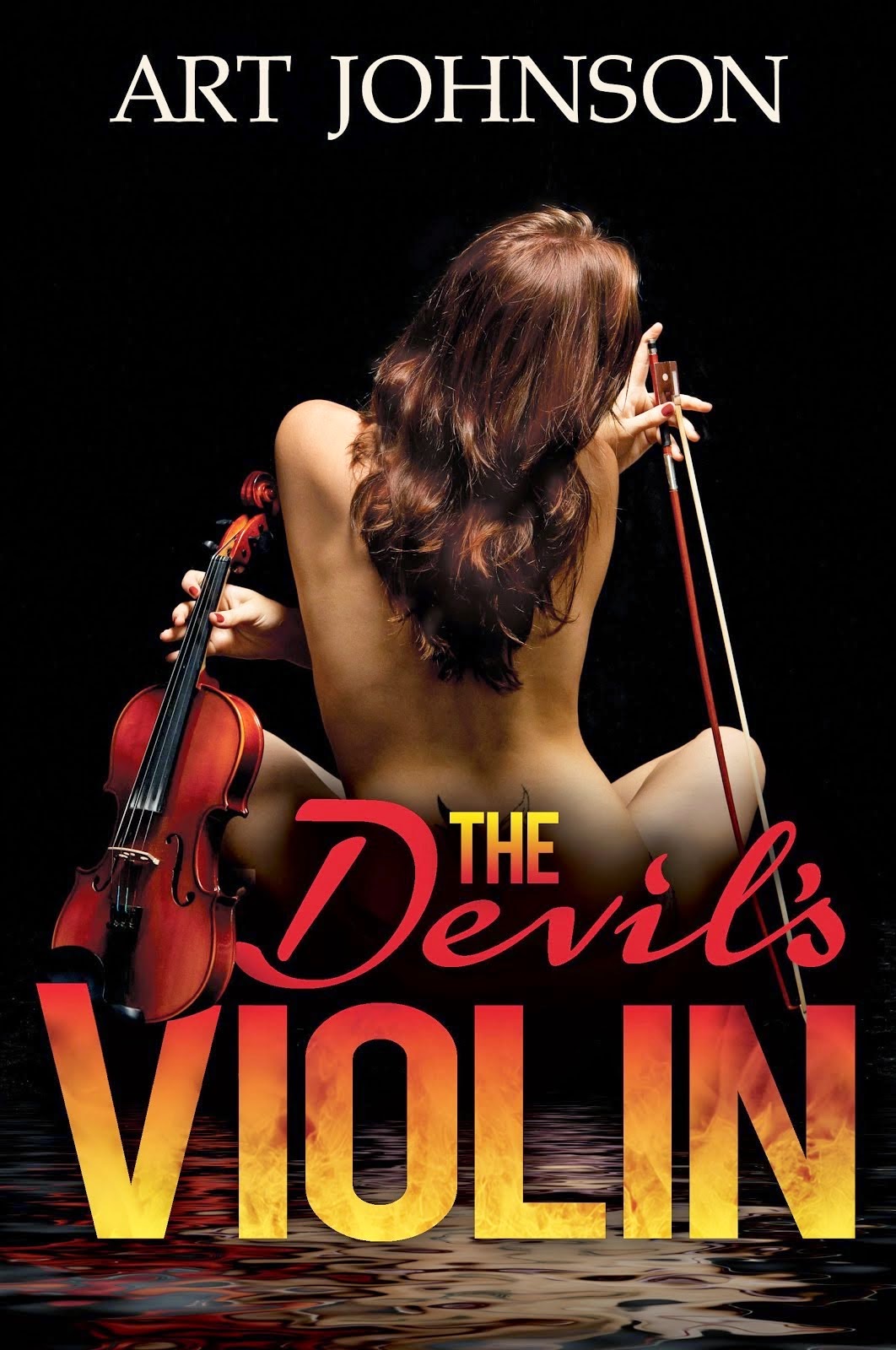
Art is also a dedicated writer, a published poet and novelist with a decidedly metaphysical slant to his work. His most recent book The Devil’s Violin combines a mystery about the disappearance of Paganini’s violin with a symbolist’s deep resonances and arcane references.

In the picture above he holds the first guitar he built; it later became my very first serious guitar. I remember mutely longing after it, for its great sustain, meaty tone and gunmetal blue and black finish. Eventually he sold it to us cheap so we could have a good axe. That’s what it looked like before riot grrrl inspired me to plaster it with stickers. When it was new, on that balcony, that’s right, in Silverlake, in the 1990s.


Ronnie plays Art’s guitar the night Lucid Nation opened for Bikini Kill.

I’ve been lucky to have great mentors like Art. From his exasperation when I tried to play power chords with dainty fingertips (to which he responded: “Dudette, they were sharecroppers with big scarred hands, just put your fingers over there and play the goddamn song.” To his wise advice: “When they stop telling you how good you are is when you’re really getting good,” but then to the sobering revelation “they call you a genius then they never call you.” Never ending punch lines interweaved with insights from Plato or Blavatsky, but then back to the punch lines. Not only could I ask him any question about music, he even appreciated my rejection of it as punk took over my life.

These days Art lives on the Mediterranean with that love of his life he waited so long for, a painter it turns out. He’s an inspiration to everyone who dares to take a less traveled path. I’m delighted to introduce you to a true friend of the arts.


Your father had something to do with inventing color TV? Was he truly evil or just twisted?


Evil and twisted may both apply. He was an electronic genius and even in the early fifties we had televisions all over the house. The first color set was in 1959—where else? In our house.

What was it like growing up as a quirky musician in the America of the 1950s?

Actually I didn’t start playing the guitar until 1963. I was seventeen. When I worked with Alan Holdsworth opening up solo for his trio at his request a few times in California before I left for Europe I found out that he didn’t start until he was seventeen also! We were both told that we didn’t stand a chance of making anything of ourselves because we started too late. Great laughs.

However, I began to become aware of music in the 1950’s. You had a telephone in your house, black and white TV, radio, phonograph players and most homes had a piano. In our house there was no music played. I started on the accordion at the age of seven. By the time I was eleven, after four years with the accordion, I hated music.  Later when I was maybe fourteen I heard for the first time on the radio, Andre Segovia, Barney Kessel, Elvis Presley and Little Richard. This was all before the Beatles became a band!

America was much different then. It is hard to explain to people the simplicity of life and the uniqueness of choosing a musical direction. There were not hordes of musicians in those days, particularly in the jazz field. It was a very select club and hard to enter. There were no cassettes, no instruction books, no videos, no cable, no computers. Christ, the Walkman cassette player didn’t come on the scene until 1979.

You had vinyl records and a turntable. You listened and tried to copy what you heard from the great players and then you went out at night to clubs to listen some more. You practiced and you listened. That was it. If you got lucky maybe a jam session would get you some attention. It was definitely not an easy path. The one advantage during the 50’s and 60’s was the amount of nightclubs and bars that had live music. That element does not exist today and it is too bad. In those days it was hard to get lessons because the musicians who were playing out a lot didn’t have time to teach or just didn’t want to.

One night a few years back I was working with a famous jazz pianist for a club gig with a quartet. On one of our breaks, I asked him if he ever taught. He turned to me and said, “fuck ‘em, let them learn it the hard way like we did.” A blunt response but I got it!

You studied guitar with the great Barney Kessel, tell us a little about him and what he meant to you.

There isn’t enough room on the net to answer this question fully. Briefly, I took a handful of lessons from Barney after arriving in LA in the late 60’s. He then moved to Europe and I didn’t see him again until he returned two years later. My real time with the maestro started in San Diego after we both ran into each other at the bank, neither knowing that we had moved to SD. I spent the last ten years of his life with him and he was like an advisor/father figure to me. He produced my “Solo Jazz Guitar” CD and to my knowledge I think I am the only guitar player he ever endorsed. He was one of the funniest mo-fos I ever knew and of course the godfather of all modern electric guitar playing. He took over from Charlie Christian and bumped it up a few notches. He was a real friend as well as a mentor.

Your first gigs involved some locales that most musicians of the time who shared your tender age and pigment would never have dared? Tell us about that one when the gun dropped out of somebody’s suit on the dance floor.

Actually I would say that I owe most of my true schooling to the black community of musicians and vocalists that I have worked with over the years. When I was nineteen I went to late-night all black jam sessions in downtown San Diego which at the time was a risky place to be. The first night I tried to sit in a man pulled a knife on me when I went into the head to wash my hands. I stood my ground and stared him down. He smiled while folding up the cutlery and said, “…you’re alright, my man, you can stay.”

My truly treasured years were spent at Memory Lane in the Crenshaw district on the south side of LA. Between 1970-81, I played there with Willie Bobo, Papa John Creech, O.C. Smith, Eddie ‘cleanhead”, Charles Brown, Big jay McNeely and many others. Generally, I was the only white guy within miles of 101st and Adams.

In 1980-81, I worked there with the two great singers O.C. Smith, and Spanky Wilson. We performed Friday and Saturday nights and a Sunday brunch.

The people of the black community were all class. They came dressed up like the evening meant something. One night there was a local who had tilted the bottle a few too many times. O.C. was singing a ballad, the lights were low and the crowd was really into it. You could hear a pin drop there was such a hush of concentration.

Then it happened. The MF started to walk across the dance floor in front of O.C., weaving like hell ready to fall over with each step. He got about halfway across when his silver-plated, pearl-handled .38 Colt oozed its way out his pants and smacked the parquet-wood with a loud thud. He was so stoned he didn’t realize what had just happened. He had a goal: get to the other side of the room.


O.C. Smith
O.C. was singing with his eyes closed. The sound pulled him out of his reverie. Without missing a beat he quickly assessed the situation and calmly said, “…dropped your piece bros.” and went right back into the song with nothing lost. We all froze.   There was a dramatic pause in the room then O.C. suddenly realized what had just taken place and he began to laugh and the whole room joined him as a roar rang-out along the walls.

The owners Larry and George simply picked up the gun, stuffed it in the customer’s waistband and escorted him to the front door.

He was back the next night sober as hell: didn’t remember anything.

Shit happened then that you could not make up. Memory Lane was the last of the real nightclubs that were born before World War II or just after that. It had an atmosphere, which has since then disappeared for the most part.

You once told me that Laurel Canyon in the early 1960’s was unlike anywhere you ever were before or after. Tell us some highlights and lowlifes of the time?

It was like living in Shakespeare’s “Mid Summer’s Nights’ Dream”. Here you were in the middle of LA in a mountain/forest. The nights were magic – you could feel the fairy dust in the atmosphere. In those days it was the exclusive residence for all of the west coast crazies. Poets, authors, philosophers, folk musicians, jazz and rock players, beatniks, hippies, singer-songwriter’s, you name it. Add to that the newly emerging drug culture and you’ve got a hell of cocktail! Once again, I must remind folks that it was simple times, life etc.

As an example of the lifestyle, I rehearsed nearly every day in 1969 up Lookout Mountain in an experimental fusion trio with Skip Battin (later bass player with the Byrds) and Eddie Ho (drummer with Zappa). We had a rehearsal garage next door to “Papa” John Phillips. One afternoon when we came out for a break he was standing there smoking a joint and he said, “…what in hell is that shit supposed to be?” The three of us looked at each other stoned out of our minds and just start laughing. That was Laurel Canyon.

You were voted most promising jazz guitarist by Leonard Feather after your performance at the Monterey jazz festival in 1970. How did that impact you life and career?

It was really weird because just before I walked on stage I got the word that Hendrix had just died. That’s right I’m walking out to play Monterey a few hours after Hendrix passed, whose career was made on that stage three years earlier. I don’t remember a damn thing about the performance. I guess it was ok because LF gave me a nice review. Actually reviews can have very little impact on a career unless you are already famous! But the reviews I received when I first came on the scene in ’68 were very beneficial. The music business is like anything else. Right time/right place.


Art rocks the pink trousers (L) with Tim Buckley at Knebworth in 1974.

What was it like touring with Tim Buckley? Was that the first time you felt yourself levitate on stage?

I was recommended for that gig by James T. Fielder, the original bass player with Blood, Sweat and Tears. I arrived for the audition and Tim was already there playing his Fender electric 12 string like a mad devil. He was a great guitar player and I’m not sure the public really knew that. So I introduced myself and we began to jam just the two of us. He said, “I can tell you love Django Rheindhart…wanna jam on Sweet Georgia Brown? And off we went. Tim was a unique person. Our first gig was a concert in Detroit in 1974 at the State Theatre downtown. We were opening up for Chick Correa. We were all over it from the first tune. When my guitar solo came up Tim looked over at me and motioned with his head to come where he was into the spotlight. I will have to admit that in those days I was quite a guitarist with mega-chops and ideas to match. Tim egged me on “…kick their fucking ass Artie…” he yelled at me just as I arrived center stage…and guess what? I did! Honest to gosh truth I got so into it that I felt my feet lift off of the stage…serious. The crowd went nuts and for over a year we did this all over the globe. We were planning on recording when he overdosed. It’s funny, I remember teaching a four-year-old Jeff Buckley how to cross the street by looking at the walk/don’t walk signs. Lotta time slipped by since those days.


Please tell us your favorite Miles Davis story.

 
Well actually I only have one. I was playing with Shelly Manne’s group on a Thursday night and Miles was due in to play that weekend at the Mann Hole, Shelly’s club. We were in the middle of the first set when I saw a black man in a white mink coat and hat walk in the club. Shit, it’s Miles I thought to myself. I tried to pretend that he wasn’t there. When we took a break Miles and Shelly were talking by the bar. Suddenly Miles broke away and came over where I was standing. He got right in my face, looked up at me and said, “You know what?” and I said “nope” and he said “…You don’t play too bad for a white boy.” Without thinking I responded “…Thank you God.” He smiled.


You toured with Lena Horne accompanist and occasional arranger. Tell the people what she told you in the limo when you thought you were going to get fired.

We were doing two shows a might at that venue in Toronto. Lena really only had one complete set. It was the second show of the last night. So when the crowd stayed over from the first show she got really nervous. She was afraid they would notice that she was doing the same set again. She started to yell at the band on stage because she was forgetting her lyrics she was so wigged out. She didn’t realize that she could have just been reciting the phone book from the greater Toronto area and they would have been happy. Anyway the vibe was really bad.

After the show her management said there would be a band meeting. I chose to forego the privilege and I went back to my room. The next day we were due to fly out back to the states. Her limo was in front of the hotel. I started to head for the band van when her manager told me that Lena wanted me to ride with her. I thought: “okay, time to look for a new job.” She and I were squeezed into the back seat. We drove for a few minutes she didn’t say a word. I waited. Finally she looked over at me and said “…all us canaries are a pain in the ass, right?” Without hesitation I looked at her and said, “You got that one right!” A few moments went by then she grabbed my hand and gave it a squeeze. Real class. She, in her silent way apologized.

More fun to tour with Lena Horne or Paul Horn?


Loads of fun with both – just different.

Is it true that Pat Boone’s shows attracted the nastiest groupies?

No comment.

You worked on soundtracks for the classic Robert Altman films Nashville and Welcome to L.A. What was that experience like, and how did it differ from the work you did for television soundtracks?

Things were loose on Altman’s set. He was an improviser. They’d be setting up for a scene and he’d wander over to Harvey Keitel or Geraldine Chaplin or whoever and whisper something in their ear. They’d give him a funny look and then with that child-like look in his eyes he’d say,” …okay, let’s try one.” I never saw him with a script in his hand.

At 20th Century Fox, or Universal or Warner’s it was like a military drill. Play this music perfectly or you’ll be shot at sunrise. There was no improvisation on the lots in those days—all business.

How did you become friends with Manly P. Hall?


That’s a tough question to answer. I never had the feeling that Mr. Hall was compelled to have his time wasted by people whom he could not experience a certain mood or atmosphere with. His social circle included Hollywood stars, dignitaries, schoolteachers and janitors. He seldom engaged in intellectual conversation. If someone tried to drag him into a dissertation on a certain Neo-Platonist he would reply by asking the person what chance he or she thought the LA Dodgers had this season. I was around him several days a week for seven years. He guided me without formality, he encouraged me without obvious intent and he most of all laughed with me when I would roll out my 1961 Pontiac and give him a ride home. I never tried to engage him in intellectual exchange. I thought that he probably didn’t need my take on the twelve books of Aristotle’s Metaphysics.

I actually started working there recording his Sunday lectures from 1982-88. I loved going into his office to get him for his lecture and finding him bent over the comic strip section of the New York Times with that mischievous smile on his face.

Tell us your favorite story or two about your time at the PRS.

In the early eighties after I started working there part-time I became absorbed in reading and writing poetry. From the ancient Greeks to the 20th century I couldn’t get enough. I read bios, histories of the times the poets lived, their letters, their influences, books on the Hermetic Arts, etc, I never mentioned it to Mr. Hall. Why should I? He has better things to think about.

But one day I was driving him home at the end of the day and he didn’t utter a word. I took the cue and kept my mouth shut. When I pulled into his driveway and made the turn to let him out, he opened the door and turned to me and said, “You know that poetry is one of the best means of initiation into the mysteries.” Boom! Bomb dropped. He alighted from the car on his own, gave me one of his unique smiles where it seems his eyes become oriental and he wished me a good evening.

That should do it.


You’ve preformed Brazilian music with Jobim, blues violin, traditional jazz and fusion, you’ve played every instrument on rock and pop recordings, performed classical and you’ve performed Renaissance lute recitals, what inspires you to study so many different instruments and styles of music?

I think it is just the fact that I’ve spent a lifetime as a curious person. If something attracts me I have to investigate it. The guitar is one of the most unique instruments on the face of the planet. It is comfortable with all styles of world music including Classical, jazz, folk, rock, Country Western, Flamenco, African, and on and on.

My own desire has always been linked to the need to replicate the sound—to experience the creation of the sound. Of course, it also helps to be out of your fuckin’ mind! My time spent on the violin, the most difficult of all instruments to play, was merely intellectual revolution. You can’t push a button or program a sound-byte, you have to really be able to make the sound—the violin is the most satisfying to play when you have it under control. The problem is that doesn’t happen very often.

How many years have you been writing poetry? What is your goal as a poet?

Nearly 35 years. I don’t think poets can afford goals. It is the personal reflection of the universal as it applies to the subjective interpretation of experience. Poetry is the thinking of feelings. A goal? To not have someone throw it away after I’m dead.

One of the most amazing things about your career of great accomplishments is that you had to fight disabilities to do so. Where did you find the courage and dedication?

I was just too stupid to realize I was handicapped. It’s that simple. I never thought about how to cross the road—I just went over to other side. Period.

You live in Monaco now. What do you like better about Europe? How does America look from over there?

I’ve been here with my French/Monagasque wife for around 12 years. I haven’t been back to the States since 2009. It would be difficult to describe Europe as ‘better’ than the US, just different. For one thing, France will fit inside of Texas. And Monaco will fit inside Central Park. So there is this aspect that needs to be acknowledged. France is still basically an agricultural, economically driven country: lots of farms, vineyards, and produce stands along the side of the road, etc. There are many cheese commercials on TV! The pace of life is slower, especially in Italy where each day is valued.

In my book “The Devil’s Violin”, there is a description by FBI Agent Chris Clarke about a late afternoon in the plaza of Cremona. He comments on the Italian way of living. It is drawn from real life—something I experienced first-hand.

There are less computers per capita, more readers who want to hold a book and not stare at a screen to read. There is not the tragic tension of terrorist doom, which seems to be dominant in the States. When you go for a drive there are no highway patrol cars on your bumper feeding your license plate into a computer. Bottom line, it’s more relaxed. Also, Sunday is a real day off. Very few stores open.

America is still revered by Europeans for the most part. However, they really can’t understand this thing about constant gun violence, which is occurring more often in the USA. They love to visit the US and always come back with a gleam in their eyes telling everyone what a wonderful time they had and how friendly Americans are.


You recently had your first novel “The Devil’s Violin” published by Story Merchant Books, a blend of Hermetic metaphysics and a thriller with Paganini’s violin front and center. What inspired you to write the book, how is it doing and will you write more?

Actually the book wrote me. I was staying with relatives in a village not far from Parma Italy and before turning out the light one night the names of half a dozen characters came to me with brief descriptions of each. I turned out the light and lay down then flipped the lamp back on and wrote down some notes. I knew better than to think that I would still remember it all the next day.

So, that morning at breakfast, a dozen Italians were asking my wife why I wasn’t eating. She just told them, “…he’s writing a book, he’ll be with us shortly.” I wrote six rough chapters then returned to Nice and shelved it for six months. When I got back to it I just sat down and in a few months the first draft was complete. I re-wrote it several times and almost had a publisher in Ireland put it out but they ran out of funding from the government.

Along comes my long time friend Ronnie Pontiac and he introduces me to Ken Atchity at Story Merchant Books. Ken liked the story but insisted on a complete re-write. So, off we go again. Seven months later it is published as a kindle and paperback and for a first time fiction writer it has become, as Ken states: “…a minor sensation.” I have no figures on sales for it has only been in the market place on Amazon for four months.

The metaphysical aspects of the story are slight and just came to me as part of the progression of the story and nothing more. People are surprised when I tell them that I never use an outline. That habit is probably a hangover from writing poetry. I never expected the Hermetic side of the novel to even make a dent in the consciousness of the reader but several reviewers have explored that aspect of the story.

I haven’t any idea what I’m going to write when I sit down at my desk. It just starts itself and the characters talk to me and offer direction.

I am now writing a spin-off of the Devil’s Violin which has some of the characters involved. I would not call it a sequel but it’s close to it.

I think that it is important for people to realize that the creative process on almost any level is magical. When you write a song, or a poem or compose instrumental music, paint or sculpt, you are making visible, or audible, the invisible. The foundation of transcendental magic is merely the permutation of the elements. An idea is drawn from a universal consciousness and we should never take full credit for our art. There is always something unknown that contributes to our creative process.

That’s the fun of it.

When you’re at home, having played so many kinds of guitar styles, what do you gravitate towards when you practice?

That’s a good question. Honestly, I have two Flamenco guitars from Spain and as I live on the Mediterranean Sea, it’s just across the street from my apartment, and the boats are docked within my view, I generally play MY version of Spanish Guitar. Flamenco mixed with Brazilian and a pinch of jazz thrown in for good measure. I love acoustic guitar over electric although most of my career has been spent dealing with lugging amps around.


 What are your current musical projects?

I am not at this time doing any concerts or club dates. Last year I signed a lifetime contract with ITI Records Incorporated/Warrant music. They are affiliated with Sony’s digital arm, The Orchard. I have several projects available online from ITI records through iTunes or Amazon including straight-ahead jazz, fusion and World beat. My newest project is online now and is a World Jazz CD entitled “One Man”. I’ve composed all of the music and I am playing all of the instruments: Guitars, violin, mandolin, keyboards, bass and programmed drums and percussion. It has been out in digi-format for a few months and over 35 countries have streamed it with the US and India at the top of the list. ITI is releasing it as a CD in august. Your readers can hear a sample at Youtube/ ITIrecords -There is a video along with the track.

I am also their executive consultant which I am donating my time pro-bono. All of my profits from sales I turn back over to the company because they are using the money to develop new talent and get some fresh faces in on the scene. I feel that this is very important for the future of live music as well as recorded works. You reach a point in your life where it is time to give back some of what you got. Simple.


Article Written by Tamra Spivey

Newtopia staff writer TAMRA SPIVEY is a founding member and primary singer of Lucid Nation, executive producer of the documentaries Rap is War and Exile Nation, and associate producer of The Gits documentary. She was art editor and west coast editor of Newtopia Magazine in its former incarnation, collaborating on in depth interviews with whistle blower Michael Ruppert, ACLU and record business honcho Danny Goldberg, and grassroots political strategist Larry Tramutola. Follow her on twitter @MongrelPatriot.

Einstein and the Violin


Einstein's mother, Pauline, was an accomplished pianist and wanted her son to love music too, so she started him on violin lessons when he was six years old. Unfortunately, at first, Einstein hated playing the violin. He would much rather build houses of cards, which he was really good at (he once built one 14 stories high!), or do just about anything else. When Einstein was 13-years old, he suddenly changed his mind about the violin when he heard the music of Mozart. With a new passion for playing, Einstein continued to play the violin until the last few years of his life. For nearly seven decades, Einstein would not only use the violin to relax when he became stuck in his thinking process, he would play socially at local recitals or join in impromptu groups such as Christmas carolers who stopped at his home.

Music for fun and physics 

Music was not only a relaxation to Einstein, it also helped him in his work. His second wife, Elsa, gives a rare glimpse of their home life in Berlin. “As a little girl, I fell in love with Albert because he played Mozart so beautifully on the violin,” she once wrote. “He also plays the piano. Music helps him when he is thinking about his theories. He goes to his study, comes back, strikes a few chords on the piano, jots something down, returns to his study.”

In later life, his fame as a physicist often led to invitations to perform at benefit concerts, which he generally
Bronislaw Huberman and Einstein
accepted eagerly. At one such event, a critic – unaware of Einstein’s real claim to fame as a physicist – wrote, “Einstein plays excellently. However,his world-wide fame is undeserved. There are many violinists who are just as good”.

One wag, on leaving another concert in which Einstein had played, commented, “I suppose now [the Austrian violinist] Fritz Kreisler is going to start giving physics lectures”.

There are nevertheless conflicting accounts of his musical abilities. Probably the least generous come from great artists, of whom Einstein counted many as personal friends as well as chamber-music partners. These included the pianist Artur Rubinstein, the cellist Gregor Piatigorski, and Bronislaw Huberman, one of the most remarkable and idiosyncratic violin virtuosos of the 20th century.

In 1936 Huberman visited Einstein in Princeton to discuss his plans to found the orchestra that eventually became the Israel Philharmonic, of which Einstein was a prominent supporter. Probably the summary of Einstein the violinist that comes nearest to the mark comes from his friend Janos Plesch, who wrote, “There are many musicians with much better technique, but none, I believe, who ever played with more sincerity or deeper feeling”.


Mysteries Galore Reviews The Devil's Violin

Reviewed by Dianne Woodman


The Devil’s Violin begins with an act from the past that sets in motion an unexpected chain of events tying all the players involved in the story together. Niccolo Paganini, a world famous violinist termed by many as the Devil because of his extraordinary skills, is on his deathbed in Italy. Niccolo has promised his cherished violin to the mayor of Genoa so that it can be put on display in the museum. However, he wants the 1742 Guarneri to remain in the family, so he hides it along with secret documents that are inside the case under the floorboards in his apartment and leaves an exquisitely crafted forgery of the instrument for the museum. He plans to tell his son where the real violin is hidden, but dies without revealing his secret.

The story then moves forward to the present day in Los Angeles. Max Pendleton, a Hollywood film producer, hires two top-notch thieves to steal the violin from the museum. Plans for keeping the heist under wraps go slightly awry when a violinist in Italy is found with his throat cut, and the man fleeing the scene is described as a man dressed all in black. This act triggers a manhunt led by Special FBI Agent Chris Clarke for the man in black, since the MO at the murder scene is consistent with a contract killer who has eluded the FBI for years.

Art Johnson has artfully integrated believable and relatable characters into a story filled with violin history, secret societies, deception, intrigue, greed, and non-stop action that keeps the reader invested in the outcome of the story. The tension builds throughout the novel culminating in a nail-biting confrontation in Italy between the players who have a vested interest in locating the violin. There are surprising twists and turns in the plot that makes for an engrossing mystery thriller. The few minor grammatical mistakes do not detract in any way from the overall enjoyment of the story.

The author has left it open for this book to be the beginning of a highly entertaining and captivating series. There are unanswered questions involving a couple of the key players who assisted the FBI, and Special FBI Agent Chris Clarke has a new case to solve.


Reposted from Mysteries Galore


Part Two: Can you tell a fake instrument from the genuine article?


New technology has makes it easier for experts to communicate with each other and share their knowledge.

Digital photography and database software have also made it much easier for dealers to record what they have seen and keep comprehensive archives.
  Florian Leonhard, a London-based restorer and dealer of fine violins says ‘Any expert always needs photographic references.' We can store a lot in our brain, but we can’t always go through 10,000 instruments in our mind. A computer database helps us, and having digital images means I can type in features and find things more quickly.’In the past few years, there have been important advances in a number of scientific techniques that can help shed light on the physical properties of instruments. Perhaps the most prominent of these has been dendrochronology, the process of determining the age of wood by analyzing the patterns of tree rings. But according to Christopher Reuning, a dealer and restorer based in Boston, it is not always conclusive. ‘It can tell you a number of things,’ he says. ‘If the tree was cut down after the instrument was allegedly made, then the instrument can’t have been made by that maker. But dendrochronology can’t prove; it can only disprove – the tree can be much older than the instrument, because the maker might have used older wood. Dendrochronology is often used to confirm what you already think and to ensure that you’re not making a mistake.’

Arguments over the usefulness and authority of dendrochronology reached a head in the late 1990s with the claims and counterclaims over the date of the ‘Messiah’ Stradivari. American expert Stewart Pollens asserted that the ‘Messiah’ could not be a Stradivari, based on findings by two German dendrochronologists that suggested that the outermost tree ring of the violin was formed in 1738, a year after Stradivari’s death. But a dendrochronological analysis by British maker John Topham contradicted those findings, dating the outermost tree ring to 1682. Many prominent dealers always had their doubts about Pollens’s claims, and in 2001 a group of US scientists presented new research that backed up Topham’s dating of the outermost ring.


Another emerging technology is varnish analysis. Research by scientists in Paris has shown
Varnish Sample from an instrument by Antonio Stradivari
that Stradivari used a very simple recipe of oil and resin to coat the wood of his instruments, so if any other chemicals are detected as major constituents, it is likely that the instrument is a copy. However, varnish analysis is a very new technology and cannot yet be entirely relied upon. ‘I increasingly use dendrochronology, and for some cases wood analysis,’ says Hieronymus Köstler, a dealer and maker in Stuttgart, Germany. ‘Varnish analysis will also be quite helpful in future, but the techniques are not refined enough today.’

So has all this left the fakers quaking in their boots? Not exactly, according to Michael Sheibley, a luthier in Pennsylvania. Sheibley says that makers are still producing copies good enough to fool most dealers – and he reckons he is one of them. ‘It goes on all the time,’ he says. ‘In the past, experts didn’t have the kind of equipment that is available today. But there are different levels of experts, and some of them are easier to fool than others.’

‘I’ve done things that have alarmed experts,’ he adds. ‘One day I went to an expert with a case of violins I had made. He was not able to identify them, and it took me ten minutes to convince him that I’d made them. He and his colleague stood there wondering how this could happen. Let’s call it a gag – these experts are not the experts people think they are. I have, in the past, enjoyed putting egg on their faces for my own self-gratification.’

Sheibley says that although technology can determine certain things, the best experts have seen so many instruments over so many years that they can simply rely on their own experience and instinct. ‘You have to smell it,’ he says. ‘You have to have it ingrained in your being.’

Other experts agree that there is no substitute for experience. ‘Recognition of a maker’s work is the most important thing,’ says Reuning. ‘An expert should sell on his or her own conviction. You should make a decision based on what you really believe. Someone who is a real expert will form an opinion based on their personal knowledge.’

Köstler agrees. ‘The most valuable safeguard is an understanding of originality and knowledge of the historical background and construction of instruments,’ he says. ‘Scientific tools can be time-consuming and difficult to use. Technical analysis or dendrochronology are of course very important, but you need to know a lot to use these tools.’
According to Florian Leonhard, a London-based restorer and dealer of fine violins, says technology can only do so much. ‘Nothing replaces the experience of having seen originals,’ he says. ‘You have that in your mind, and then you compare. You try to place the instrument in a school, looking at things like the colour of the varnish, the f-holes and the age. You have to know all the makers very well to know whether an instrument is fake, because many things could match and it is hard to prove. In a good fake, I will often see many features of the maker. There are a multitude of things that add together and they all have to be right – the inserts, the scroll, the channelling, the inside work. You are like a doctor trying to diagnose a patient with a rare tropical disease – there are so many boxes that have to be ticked to get the right diagnosis. The brain is still the best resource.’

Read more  


Interview - Art Johnson - Jazz Guitarist, Violinist, Composer and Author of The Devils Violin

Photo prise par Olivier Perez


Art Johnson is an American born Jazz Guitarist, Violinist and composer who has recently written the novel The Devils Violin. Art thanks so much for granting us this interview. The Devils Violin holds a 4.7 star review on Amazon and is reviewed as one of the most enticing mystery thriller novels to date.

Art based on your very musical background you have toured with Lena Horne, recorded with Barbara Streisand, and accompanied Pavarotti. 

You have been on MTV - participated in Academy Award and Grammy Award music, acted as a California State University professor and lecturer to name but some. Which of these have you enjoyed the most?

Touring with Lena Horne is a standout for sure. It was three years and we became good friends, which is not typical in an employer/employee situation. But in truth, all of these experiences are connected like a chain of events and each setting has had great worth to me as a human being as well as a musician.

What made you decide to write The Devils Violin?

Actually, the book wrote me! I was vacationing in a village near Parma and just before going to sleep the names of the main characters came to me with a brief description and I wrote them down before turning out the lights. When I awoke in the morning I sat at the breakfast table with ten Italian relatives and began to write the first few chapters. They of course wanted to know why I wasn’t eating.

Was it easy to cross the bridge from musician to author?

Easy …? I started writing poetry in the 1980’s so I had spent time with word-play. To me, the creative element no matter what the medium is rooted in the same source: the imagination. If it is well trained the crossing over is not too difficult.

Can you tell us a bit more about the plot, without giving away any secrets?

The violin world is extremely complex. The instrument is difficult to play, and if you want to really have a great sound it is probably one of the most expensive instruments for a person to purchase. There are violin brokers, dealers and auction houses that are tempted to alter the lineage of an instrument to make it appear more valuable.
The devils violin is about deception and greed as a cast of characters from Hollywood film producer who is obsessed with rare antiques in particular violins, FBI agents, two professional thieves, a master violin forger, and an elderly couple of great mystery who are after the violin case because it is believed that an alchemical treatise or formula that Niccolo Paganini use to expand his powers over the instrument is stuffed inside.
The FBI is after an assassin who is suspected to have killed a violinist in Cremona Italy who is on their most wanted list. All the characters, like spokes on a wheel are spinning around the violin that was used by Paganini to forge his career.

Can you give us more insight into your main character?

That is difficult because the sneak – thief Gus happy and FBI special agent Chris Clarke compete to be the main character throughout the book.

Would you ever consider adopting this novel to film?

I couldn’t think of anything I’d like more.

The novel has been available since February this 2014, to date reviews have been great. Will there be a second novel within the series?

I’m working on it as we speak. Not a true sequel but several of the characters are returning to this semi-sequel.

Does having an existing fan base compliment your novel retail?

That is difficult to say. People are generally reticent to recognize you away from what you are known for. I certainly hope that my fans will be curious enough to read the book but I’m not sure how that will work out.

 Are you looking to further your writing career?
Yes.

You alternate your performances between the U.S and Europe, have you ever thought about expanding your travels to Australia, South Africa and so on? (If you do decide to come to RSA – Johannesburg, I have just the venue.)

In the last fifty years I’ve done thousands of performances. Now I am recording for ITI records in the States who has signed me to a life-time contract. I’m taking a break from live performance.

Are there specific events, fans can look forward to? Author signings, musical appearances?

As of this moment I am just staying on Monaco where I reside with my wife Patricia and my publisher is working hard to promote my novel. It’s a wait and see period which is a very interesting one for me.

What does the future hold for Art Johnson?

Hopefully, what I would wish for everyone. Good health, happiness and the drive to continue to create and offer something of value to those around me.

What would you say has created the success behind your name?

Honestly, I have no idea. Right place/ right time maybe?

Did you ever think you’d achieve everything you have done so far?

I didn’t start playing until I was seventeen years old: very late for a start in this business. I am grateful for every achievement that has come my way.

Places where fans can connect?


Art thanks so much for giving us some insight into your exciting new world. We wish you well in this new endeavour. 

"Lover Man" by Art Johnson and Dwayne Smith

Art Johnson on violin and Dwayne Smith on piano


Dwayne Smith has been playing keyboards since he can remember and has performed with many L.A. groups including Bernie Pearl, Wilson Pickett, Jeremy Jackson and Chet McCracken of the Doobie Brothers.  His keyboard work is featured on Robert Altman's, "Welcome To L.A." and the film score, "The Best Little Whorehouse in Texas".  He has also performed with Papa John Creach, and a multitude of jazz and blues from coast to coast, including the legendary rock group, The Association.  Aside from his recordings with Art Johnson and others, he recorded his first solo, "Get Directly Down" at the famed nightclub The Baked Potato in Los Angeles. 

Memoirs of a Sideman: Lena Horn


Clifton Davis and Lena Horn in Pal Joey Revival


Nearly three years of touring with the legend Lena Horn had finally come to an end because she was about to launch into a solo Broadway show, “The Lady and Her Music”.  Her Los Angeles based quintet, who had been with her through thick and thin for several years, was being discharged for political reasons.  When you go to New York, you deal with the strongest musician’s union left on the face of the planet; New York local, 802.

The Schubert theater chain, actually the brothers Schubert, wanted Lena for her new vehicle, but only New York musicians were to be employed.

Late one night, on one of our last days of touring, we got the call from her manager at the time, Ralph Harris, a true gentleman of the “old school” to tell us that we were being let go.  Ralph was not very happy about delivering us this news and he had class enough to visit each musician in their hotel rooms to explain the situation man to man. Ralph was particularly uncomfortable with my being let go.  He knew that Lena had come to rely on me for several reasons.  My guitar playing was decent, I could, most importantly make her laugh when she needed it, and thirdly, once she discovered I could sing, we closed the show for many months singing a duet together which she had recorded earlier in her career with Harry Belafonte.  Yea, how about this, I’m singing with LENA and I’m subbing for Harry Belafonte.  

I had mixed feelings about the decision—mostly, I was glad to be headed back to LA for a rest, but I definitely would miss a lady who had become my friend as well as my boss.  She was pure class from sunrise to sunset.  She always used to say,

     “...Honey, you’re not working for me, you’re working with me.”

I had learned a great deal from her, and I think she even learned a few things from me in the process.  She had great respect for her musicians if you were cutting it.  If not, you were out the door in a “New York minute”.

Best begin at the beginning. 

Early in 1978 I was planning my second ill-fated marriage when I got a phone call from “Dad” Miller, ‘the Buddha” as he was sometimes called.

      “Hey Arturie, wha’s up?  Feel like pickin’ a little guitar?”  His smiling voice questioned.

      “What’ya got in mind, my man?”
 

Maurice then informed me that he had just joined the group to backup Lena Horne for an all-black version of the Broadway play, “Pal Joey” to be performed at the Ahmanson theater in the Dorothy Chandler Pavilion in LA for six months. 

This type of opportunity is a real good thing for a “Sideman”.  Weeks of paid rehearsals, and then a show that pays top scale for the talent displayed, and mostly, to be around someone like Lena Horne, a true one-off and a piece of active musical history on the move.  Through Lena I met Billy Eckstein, and Cab Calloway, yea, I talked to these guys, they were nice cats and very humble.

I remember our gig in Philadelphia when Eckstein was playing down the block at another theater that week.  He came to our hotel every night to hang out with Lena and talk with her musicians.  One night I greeted him coming into the hotel lobby and asked him,

     “How’d the show go Mr. “E”?

     “Son, I murdered them!”--he responded with a serious smile.

Nothing like “old-school” well-earned confidence from paying the dues big time. 

We began rehearsals in LA a month before the show was to open.  Of course, true to form, all of the music wasn’t copied yet, (meaning, probably not even orchestrated.)  There is probably no harder music to sightread than “Broadway-show business-big-hoopla” arrangements where you have millions of notes to read correctly and in actuality, few of them really count.  Music for an orchestra pit musician eventually sounds like swirls of notes, none great or small, just a sonic diffusion of frequencies.

     (Think that last sentence will get me into the Harvard school for rocket scientists?)

The weeks passed and we eventually pulled it all together and in typical “Broadway” fashion, we opened the show out-of-town to get the bugs out.  Oddly enough they chose San Diego and the old Spreckles theatre downtown, which a few years later would be totally converted into what is now, Symphony Towers. 

Having an all-black cast was very interesting.  All of the dancers and singers were pros from LA or New York and even the hairdressers, wardrobe personnel and choreographer were black.  It was to become an interesting experience to observe the role play on everyone’s part and of course the truly ridiculous way that people can take themselves so seriously for virtually zilch!  One thing about Lena Horne, they didn’t call her “Lady” for nothing.  Through most of the conflicts that arrive when one hundred or so individuals are trying to do one thing, she remained polite and courteous to all involved, in other words, a real professional.

One such incident of “cast conflict” occurred in Los Angeles when we finally began the official run at the Ahmanson Theater downtown.  I’m a musician, and although I’ve slept with a couple of ballerinas, my knowledge of dance is rather limited.  To me, everything seemed fine with the choreographer, a heavy set extremely energetic, African-American, man who seemed to be doing his job.  But, show business being what it is, one day—bam! He was history. 

The producers of the show were flying in someone from New York to take over.  The dancers were enraged.  They were absolutely not going to dance for anyone else except the man they had been working with thus far.  Back stabbing and mutiny was about to commence with dancers in huddles ready to quit if someone else landed at LAX from New York.  How could the producers do such a thing?...etc.

Well, someone else did arrive and it was none other than Michael Kidd, the original
choreographer from the movie “Pal Joey” with Sinatra and company done in the 1950’s.  Although I was an idiot concerning the hierarchy of the dance world, I knew this man’s name: it had been on the credits of zillions of Hollywood musicals and New York musical theatre productions.  Mr. Kidd was a definite heavyweight.

The hour arrived and a cast and crew rehearsal/meeting was called for the early afternoon.  The dancers were rumored to strike and just bail out of the show.  Tensions were extremely high at the time.  Lena looked worried and extremely stressed.  Mr. Kidd being the ultimate pro could feel the mood of the dancers as he was introduced to the company.  My impression at the time was that no one in this “younger” company of dancers knew who the hell this guy was as he was talking to them in a very sympathetic way about the current situation. 

To my way of thinking, not knowing who Michael Kidd was if you were a dancer would be like not knowing the name Louis Armstrong if you were a jazz musician.

There was definitely a little tension.  Lena had asked all of her musicians to be there while this “meeting” was going on, for support. Although it had no direct influence on our roles, and it seemed a waste of time, I hung in there to watch where it might go.

The spokesman for the dancers explained to the very patient Michael Kidd that they felt lost without their mentor, the one who had,

     “...Shown them the way” through this very involved production.
 
Mr. Kidd continued to show sympathy towards their dilemma but wanted to get moving along with his job.  Finally, as a “Sideman” my patience was growing thin.  The spokesman for the dancers after a long debate with Mr. Kidd about the dismissal of their former choreographer finally with great emotion began to scream out,

     “...Without him, we don’t have any motivation left amongst us...what is our motivation now?”

Before Michael Kidd could respond, with his mouth half-open, I yelled out instinctively,

“...How about your god-damn paycheck!  That’s certainly enough motivation for me!” 

My uncalled-for response sent a shock wave throughout the ensemble.  Michael Kidd held his hand over his mouth to prevent laughter, and Lena damn near fell over from laughing which she could not control.  The dancers gave me a look that would have frozen a hot enchilada and I just shrugged my shoulders. Michael Kidd had now had enough.  He clapped his hands together loudly and said,

 “...Well, there’s our answer!  Let’s get to work.”

Once again, a fine example of the “Sideman’s” prerogative to speak out even if it meant being fired.  Actually, at the conclusion of this conflict I was congratulated for my totally unwarranted comment, even by some of the dancers.

Halfway through our run of the show, Lena had her sixtieth birthday and we celebrated backstage at the conclusion of a performance one night. 

In the orchestra pit along with myself, were “Mo” Miller on drums, John Miles as the conductor/rehearsal pianist, and Bobby Haynes on electric bass.  I found out on the last night of the production that Lena had requested all of the above musicians to go on the road with her except me.  Ralph Harris, her manager, took me aside and kindly explained to me that she always toured with a guitar player from Las Vegas who also worked with Frank Sinatra named Joe Lano.  I had heard about Joe and knew he was one hell of a guitarist.  I felt no remorse and packed up my gear and headed home.  I would be called to replace Joe Lano in six months but in the meantime other interesting projects awaited my participation.

In Hollywood, this situation is a way of life for any one in the entertainment industry; you’re a hot item one day and cold the next.  What keeps you going, if you’ve got the balls, is an inert capacity to believe in yourself and have the confidence that work will always find you.  I was one of the lucky ones: work always found me.